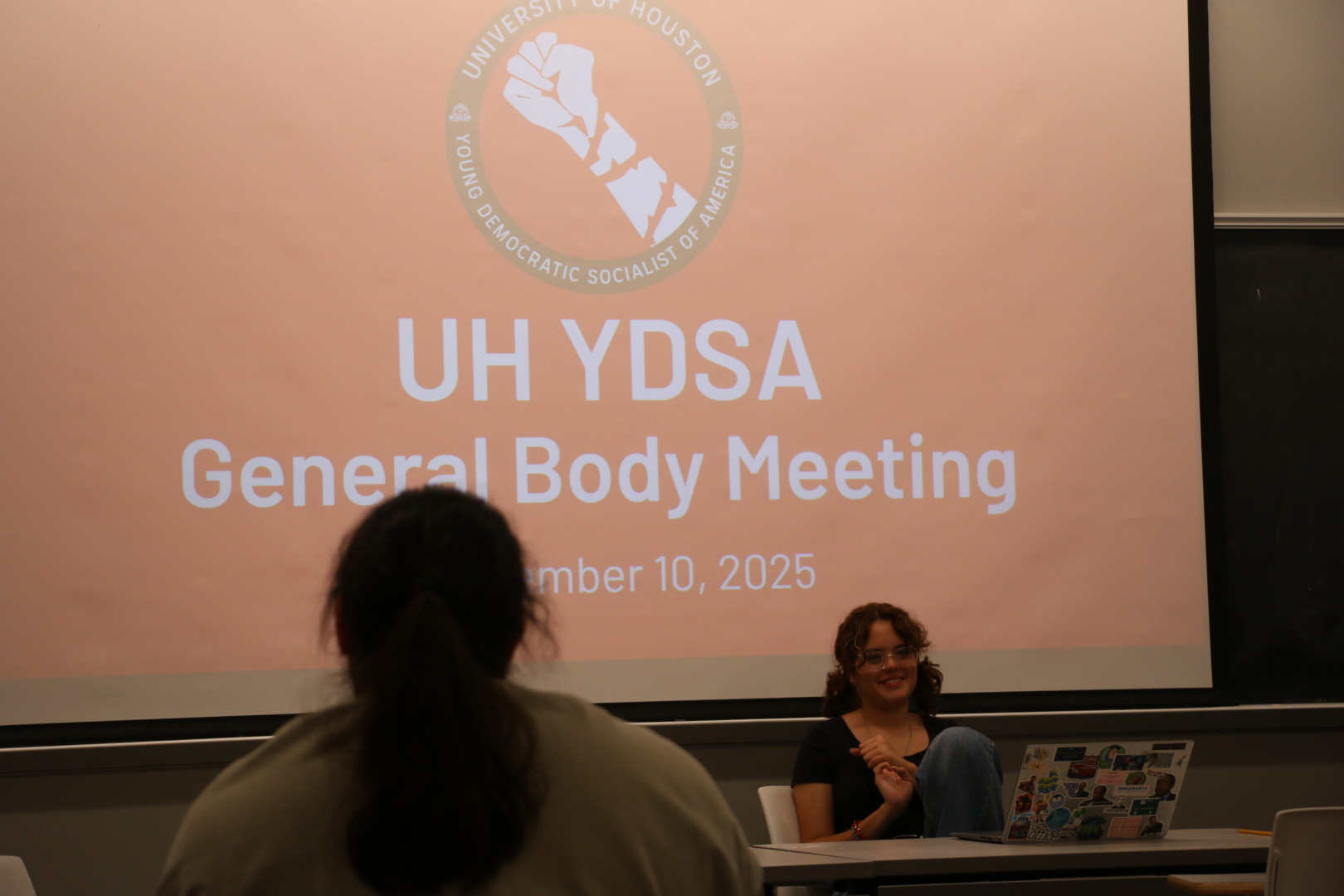
Students at a fall meeting of the UH branch of Young Democratic Socialists of America, Wednesday, September 10, 2025 in Houston, Texas. | (Karen Wei/The Cougar)
Socialism has seen a rise in support among Democrats, with a recent Pew Research Center poll finding that about a third favor political leaders who identify as democratic socialists.
Lately, several democratic socialists have won elections in the largest cities in the country. In New York, Zohran Mamdani toppled Andrew Cuomo in New York’s mayoral race. Three Mamdani-backed candidates also won their respective races during this year’s congressional primaries: Darializa Avila Chevalier and Claire Valdez, both democratic socialists and Brad Lander, a progressive candidate.
In Denver, first-time candidate and democratic socialist Melat Kiros defeated U.S. Rep. Diana DeGette, a nearly 30-year incumbent, in Colorado’s House primary.
Lawyer and democratic socialist Janeese Lewis George also won Washington, D.C’s Democratic primary for mayor, with sources predicting that George is the favorite to succeed in November’s general election.
These recent victories were led by members of the Democratic Socialists of America, a political organization that, in the last decade, has seen its membership skyrocket from a few thousand to more than 100,000 nationwide after a surge of young Americans joined following Vermont Sen. Bernie Sanders’ presidential bids.
The organization includes a youth and student section, designated as the Young Democratic Socialists of America, through which the once-taboo ideology has found its way to the University. UH’s YDSA branch has existed since 2019. In 2023, after several seniors graduated, political science senior and city-wide coordinator of YDSA in Houston Cody Szell, along with two other founders, reintroduced the UH chapter of YDSA.
Management information system junior Matthew Castaneda serves as the treasurer of the YDSA at UH. To Castaneda, democratic socialism is defined by its divergence from capitalism.
Harvard University history professor Sven Beckert defines capitalism as an economic rationale in which capital is privately owned and invested profitably, with the intent of creating additional capital.
Castaneda adds that capitalism runs off of free markets and mainly focuses on profits of the few; he believes that democratic socialism serves as a stepping stone to get to socialism.
“Democratic socialism is how we get to socialism through a democratic process, a people-powered movement where its workers are protesting and unifying the country under a class consciousness,” Castaneda said.
Some of the core issues that democratic socialists prioritize include abolishing Immigration and Customs Enforcement, establishing universal healthcare, supporting Palestine in the Israel-Hamas war and implementing progressive taxation on the wealthy.
When asked about why they think more Democrats are supporting socialist ideologies, Castaneda and Szell proposed a few theories.
Castaneda and Szell believe that frustration increased among Democrats, particularly during former Vice President Kamala Harris’ unsuccessful 2024 presidential campaign.
“During Harris’ campaign, the Democratic Party tried to beat Trump by taking on a lot of conservative talking points,” Castaneda said. “Additionally, I think that one of the main issues with the campaign was how the Democrats completely disregarded the main issues and the frustrations with Democratic voters, like the voters who wanted the party to acknowledge the genocide in Palestine seriously.”
Additionally, Castaneda thinks that both the Democratic and Republican parties have contributed to the decline in the quality of life for the working class. Szell argues that Democrats hinder progress, while the Republican Party actively works against it.
Democratic socialists, to Szell, are more attuned to citizens’ requests and concerns. He suggests that Democrats feel more represented by the core issues and objectives of democratic socialism.
“I think a lot of Democratic leadership doesn’t make decisions based on what the rest of their party thinks,” Szell said. “I think the Democratic Party would look a lot different if they actually listened to the majority opinion than what they do now.”
As a result, Castaneda believes that some Democrats began to seek out alternative political approaches, like democratic socialism.
Szell believes that since socialist policies have been successfully implemented in other countries, it’s plausible that they could be implemented in Houston as well. Other students are not so sure.
Mechanical engineering junior Gabriel Pinto said that he is reluctant to support the democratic socialist cause since he believes that socialist policies caused the economic collapse of his home country, Venezuela.
“The Venezuelan people took advantage of the free food and the free primary services, so they didn’t even want to go to work; they just used the government to get everything they needed,” Pinto said. “The government also took down so many private companies, which led to the economy severely worsening.”
Other students expressed their openness to some socialist ideas but are realistic about the likelihood of their implementation in Houston anytime soon.
Computer science senior Isabel Lara was unfamiliar with democratic socialism but after learning about the ideology, she said that she is receptive to some of their core ideas, including establishing universal healthcare and supporting Palestine.
However, Lara said that outside of Texas’ urban universities, she doesn’t predict that most residents would support those viewpoints.
“In colleges across Texas, we see a lot more Democrats and progressive movements but outside of our kind of college bubble, the reality is a lot of people are still Republicans and they don’t really like the democratic socialist movement or change,” Lara said. “This is especially true with the older generations, because a lot of them would rather keep all their money instead of allowing local governments to use their taxes.”
Biochemistry senior Steve Abolo believes that students like himself are leaning towards democratic socialism because the current state of the nation is no longer sustainable for upcoming graduates.
“I think a lot of college students were raised with this idea that ‘you go to college, you get an education, you get a degree, you get a good job ’ but now, it just seems getting a ‘good’ job is a pipe dream,” Abolo said.
Abolo said that the costs of food, housing, gas and healthcare are getting significantly more expensive; He believes people should not have to worry too much about essential resources and that implementing democratic socialist policies would bring more stability in their lives.
“The government should provide and support the people with basic essentials like food, water and universal healthcare and I personally believe that we should tax the 1% more,” Abolo said.
Abolo acknowledges that he doesn’t expect Houstonians to support democratic socialist policies in the city. He explains that this is because implementing these policies would involve taxing the wealthy, which he believes is unpopular with voters.
“A lot of people, Houstonians, do not see themselves as the average everyday guy, they see themselves as future billionaires, millionaires,” Abolo said. “When they hear that democratic socialists are going to have to tax the rich, they think to themselves ‘oh, what if I become like a super duper rich billionaire? That means they’re going to attack me.’”
news@thedailycougar.com