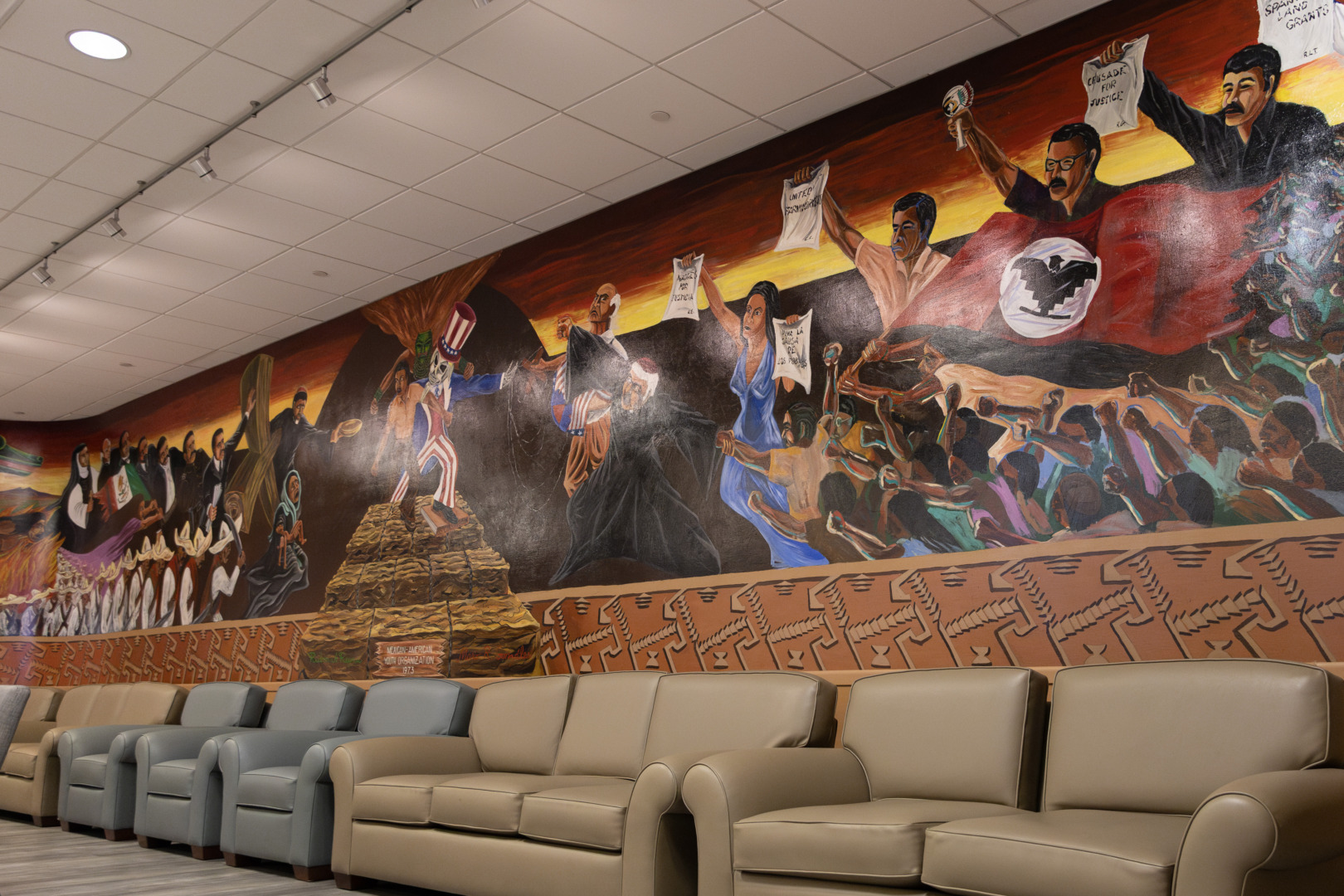
Recent removals of Cesar Chavez’s likeness around Texas call into question how UH will handle the bookstore’s Chicano mural, Wednesday, April 8, 2026, in Houston, Texas. Raphael Fernandez/The Cougar
Recent allegations of sexual misconduct against César Chávez sparked discussions both nationally and statewide, as a mural in Student Center South featuring Chávez comes under review.
Gov. Greg Abbott issued a statement that Texas will no longer honor the March 31 holiday and will redirect any material that mentions Chávez. Abbott planned to eliminate and modify Chávez’s presence in education, specifically in grade 5 and U.S. History lesson plans.
Although public universities maintain the legal right to teach, universities are still feeling the pressure of Abbott’s demand to de-emphasize Chávez. University officials are weighing in on the allegations and sticking to the school’s commitment to historical preservation.
“The University of Houston is aware of the reports recently brought forward regarding Cesar Chavez, which fundamentally shifts the historical understanding of this figure,” said the university spokesperson. “As an institution, we unequivocally condemn sexual abuse and are committed to fostering a campus environment where survivors are supported.”
The University confirmed the mural will remain in the Student Center South for now, but its specific appearance remains uncertain.
“The mural itself will remain a part of the Student Center. However, a group of campus stakeholders — including faculty, students, and subject matter experts — is reviewing how best to address the specific depiction of Cesar Chavez within the artwork,” the spokesperson said. “The group is tasked with exploring thoughtful options and making a recommendation to University leadership. This work is currently underway.”
The University has assembled a broad group for review, including representatives from the College of Liberal Arts, Katherine McGovern College of Arts, libraries, Government and Community Affairs, Architecture, the Faculty Council and student leaders.
Dolores Huerta, who co-founded the United Farm Workers with Chávez, shared that she was a survivor of Chávez’s sexual violence and coercion. As a pivotal figure of the movement, she offered her own perspectives on how to grapple with the history of the farmworker movement.
“The farmworker movement has always been bigger and far more important than any one individual,” said Huerta via social media statement. “Cesar’s actions do not diminish the permanent improvements achieved for farmers with the help of thousands of people.”
Huerta and students acknowledge the shift in recognition, moving the spotlight from one man to a collective.
“I don’t think it’s possible to completely erase his contributions, considering how involved he was in the union’s formation and growth,” said digital media freshman Zachary Westerlage. However, Westerlage suggests the controversy could offer a chance for resolution rather than disregard.
“There are other key figures whose contributions are more deserving of recognition, such as Dolores Huerta,” Westerlage said.
Other students, like finance senior David Parra, argue that an entire removal would contradict the university’s mission.
“Removal is not accountability — it is erasure, and erasure is not what a university is for,” Parra said. “UH exists to educate, and that means engaging with complexity, not curating it away.”
As the University decides what to do with the mural, students hope that educators are at the forefront of the conversation.
“Decisions about how history is taught and commemorated should be driven by educators and the campus community, not political mandates,” Westerlage said.
news@thedailycougar.com