Lily Huynh/ The Cougar
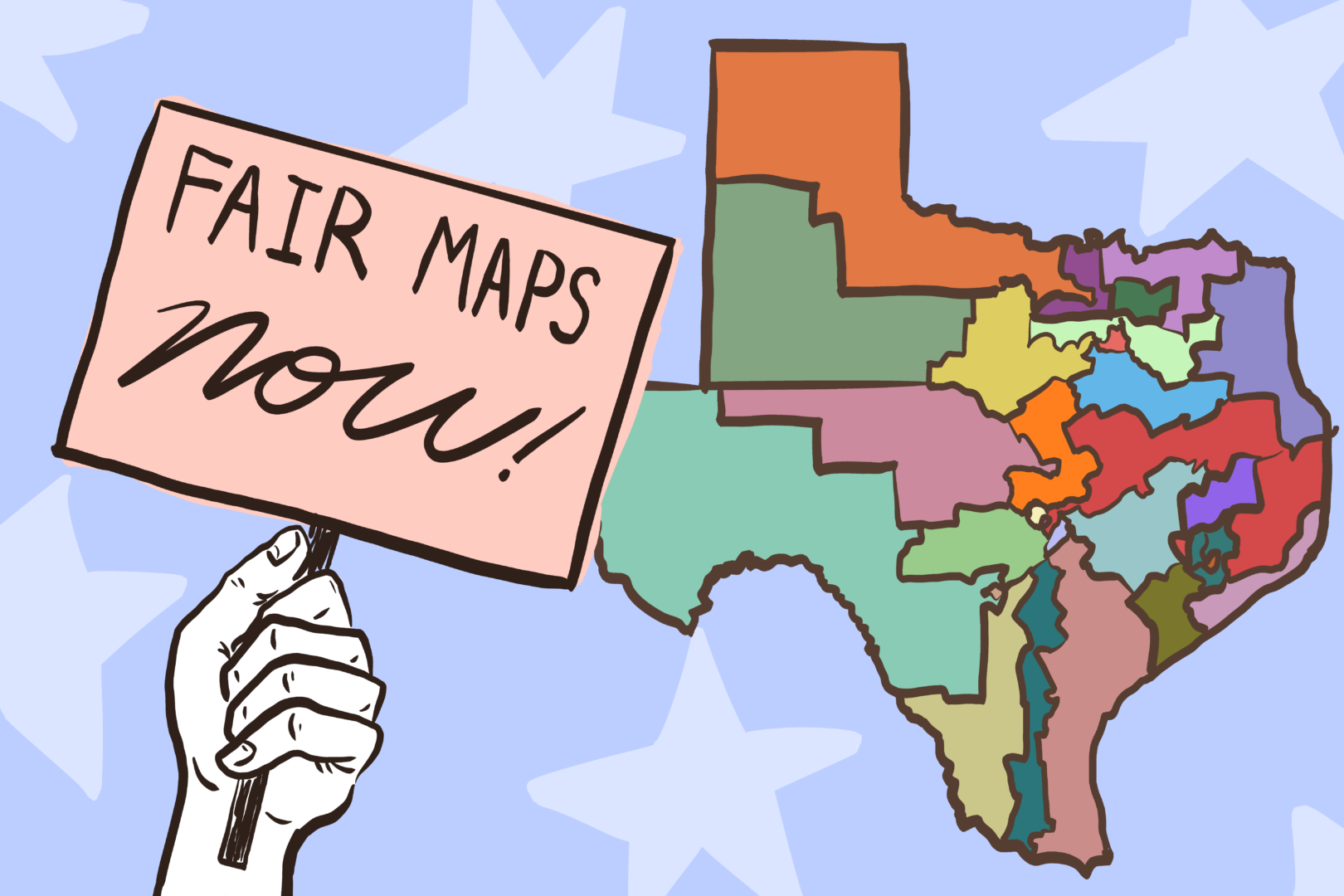
As of May 2026, a 6-3 ruling by the Supreme Court in the case Louisiana v. Callais significantly narrowed Section 2 of the Voting Rights Act of 1965.
Section 2 of the Voting Rights Act allowed voters to challenge district maps and policies that produced racially discriminatory outcomes. As a result of the decision, states now have the ability to redraw voter maps and implement laws that are predicted to disadvantage minority voters.
The decision further reduces citizens’ ability to challenge discriminatory policies in court. The weight of this decision is summed up in a quote from the director of the Power Coalition for Equity and Justice, Ashley Shelton, who said, “Without representation, what is citizenship?”
When the redrawing of district maps renders the representation of marginalized communities debatable and non-essential, it exposes representation not as a right, but as a conditional privilege.
Cracks in Legislation
The Supreme Court’s ruling overturned a congressional map in Louisiana that enabled Black voters in the area to elect candidates of their choice and challenge discriminatory voting practices.
The effects of the decision are already appearing in the Mississippi legislature, which will be among the first to consider the Supreme Court’s ruling, as Governor Tate Reeves announced he expects the state to redraw its four congressional districts in the near future.
As an NPR article notes, “The political power of Democrats in this country and Black voters in particular is likely to be hugely eroded.” This erosion of political influence raises broader questions about the purpose of representation in a democratic society.
The right to representation is foundational to democracy, arguably connected to Thomas Jefferson’s assertion that all people are entitled to the rights of Life, Liberty and the Pursuit of Happiness. How can Jefferson’s principle of life, which establishes the right to survive and defend oneself, be established if one’s humanity is acknowledged but not represented in decision-making rooms?
Cracks in Representation
The consequences of this exclusion are not theoretical but historically and materially evident. Black and brown people have only known struggle in their efforts to obtain equal treatment, consideration and opportunities in this country.
The fight for representation and visibility has been constant for Black and Brown communities who advocate for including more nuanced and accurate character portrayals, increased positive representation and the reduction of racial dog whistles and unrealistic stereotypes embedded in everyday media narratives.
These ongoing struggles reveal how inadequate representation in youth and early adulthood can diminish self-esteem and hinder self-actualization. There is no substitute for representation; one just must be present.
No one is better positioned to speak on a community’s experience than its own members. People of color have historically had to not only fight for representation but for access to the ballot box itself. When the Supreme Court strikes down a fundamental section in one of the most influential tools that prevents racial discrimination in voting, we must ask what comes next.
Cracks in the Foundation
A lack of representation harms not only excluded communities but also those already seated at the table. For perspective, imagine debating whether to buy a house, only to find that the house in question is missing its concrete foundation.
The discussion about purchasing the house is grounded in nothing, because the house itself is structurally incomplete. Without a functioning foundation, any conversation about its value becomes meaningless, since there is no stable structure on which worth can actually be assessed.
Black and Brown communities held significant roles in the creation of the United States. When we remove their perspectives from the table, we not only further disadvantage their communities but also create holes in the discussion of the legislative, administrative and political foundations of this country.
The loss affects everyone involved. There is an equivalent tradeoff in which marginalized communities will be detrimentally impacted; it is a loss on both ends: those at the table and those who aren’t allowed a seat.
In sum, alterations to the Voting Rights Act will lead to fewer Section 2 lawsuits, and further consequences will arise as maps are revised. The structural fragility of this decision will certainly be reflected in the South, where politics have not yet moved beyond race.
By allowing the redrawing of district maps, which could result in a complete lack of representation, Supreme Court Justices decided that the representation of marginalized communities was debatable and non-essential. Without marginalized perspectives, without foundational voices, the house is built to collapse, and what remains is not a democracy.
opinion@thedailycougar.com