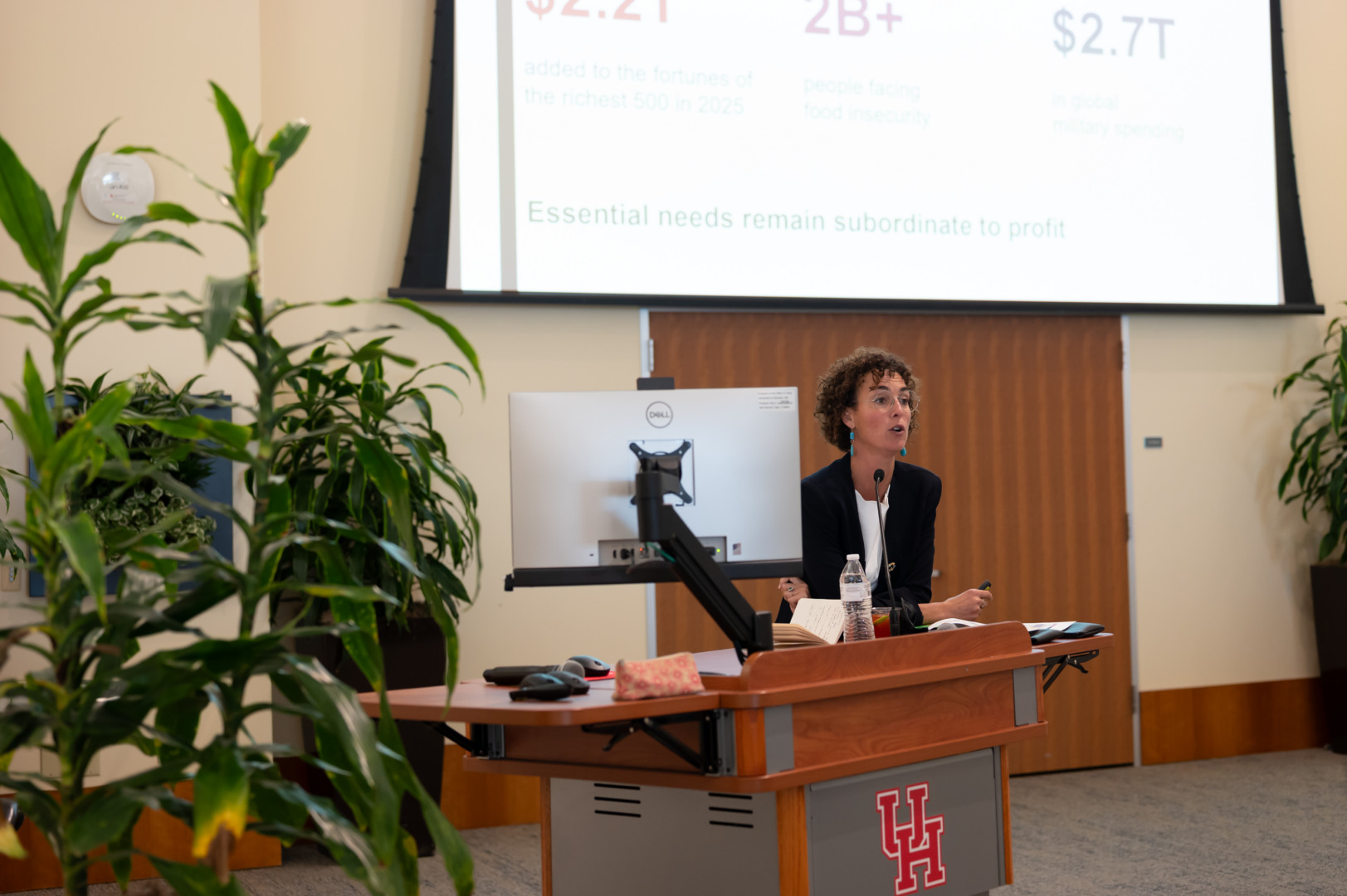
Clara Mattei speaks to the audience during “The Price of Capitalism” speech on Thursday, October 15, 2026, at the Elizabeth D. Rockwell Pavilion. | Kylie Scarrow/The Cougar
The UH CLASS Honors Program hosted Clara Mattei, a professor of economics and the founding president of the Forum for Real Economic Emancipation at the University of Tulsa, Oklahoma, on Oct. 15 at the MD Anderson Library.
Mattei spoke about austerity, a set of deliberate economic policies implemented by governments to reduce debt and restore investor confidence.
Using her historical research, she argued austerity is not a temporary emergency measure, but a permanent and fundamental mechanism of capitalism used to enforce market dependence and protect the elite.
“Market dependence is so unnatural that it actually has to be preserved constantly by forceful government intervention through economic policies,” Mattei said.
Austerity policies create cuts in social expenditures, housing benefits, health care and services of all sorts. By doing this, the capitalist state constantly shifts resources away from working people. College students, in order to afford higher education, are some of these working people.
“I remember whenever I was a student at UH,” said professor of medical anthropology and women’s health culture Chloe Levy. “I was working numerous jobs to put myself through.”
Students and professors alike attended Mattei’s talk to listen to her present her historical findings. Part of her argument was that because individuals must sell their labor to secure basic necessities, the resulting market dependence creates an impersonal coercion. This reinforces the idea that capitalism is an inevitable system.
These parts of her argument, the severe impacts of capitalism, were a major part of the discussion amongst students and professors.
“I think it’s nonsensical for school to cost as much as it does,” said junior history Joel Magee. “Just think of all the talent that is probably being lost and all the intelligent people that have never gotten a chance because of this financial burden.”
Students’ critiques on capitalism were also parts of the broader discussion.
“Capitalism has been a system that we think is supposed to help us, but it just hurts us in the long run,” said freshman english major Shivaa Mishra. “Oftentimes we’re just told to push through it, to work harder and harder and somehow that’s going to save us from a system that is inherently flawed.”
But what students, professors and institutions of higher learning can do to start overcoming the economic system everyone lives under was equally as talked about.
“One of the things we can definitely do is educate our young people who are going to a numerous careers in their future about how caring for a community or more public services can be useful,” Levy said. “This can be integrated in the system that already exists and can actually shift us towards a system that focuses on our community members as people.”
Ultimately, Mattei emphasized that academics can use historical research to debunk common tropes, rhetorical strategies embedded in economic language, used in capitalism that keep people trapped in it.
“If you use history in an intelligent way you can prove that there’s nothing inevitable to capitalism,” Mattei said.
news@thedailycougar.com