Isabel Bustos/The Cougar
Knowledge drives the world. Who has it, who doesn’t and how it can be controlled determines how people move through it.
It therefore stands to reason that people would want to be in control of how they are perceived, or, alternatively, how they are not perceived.
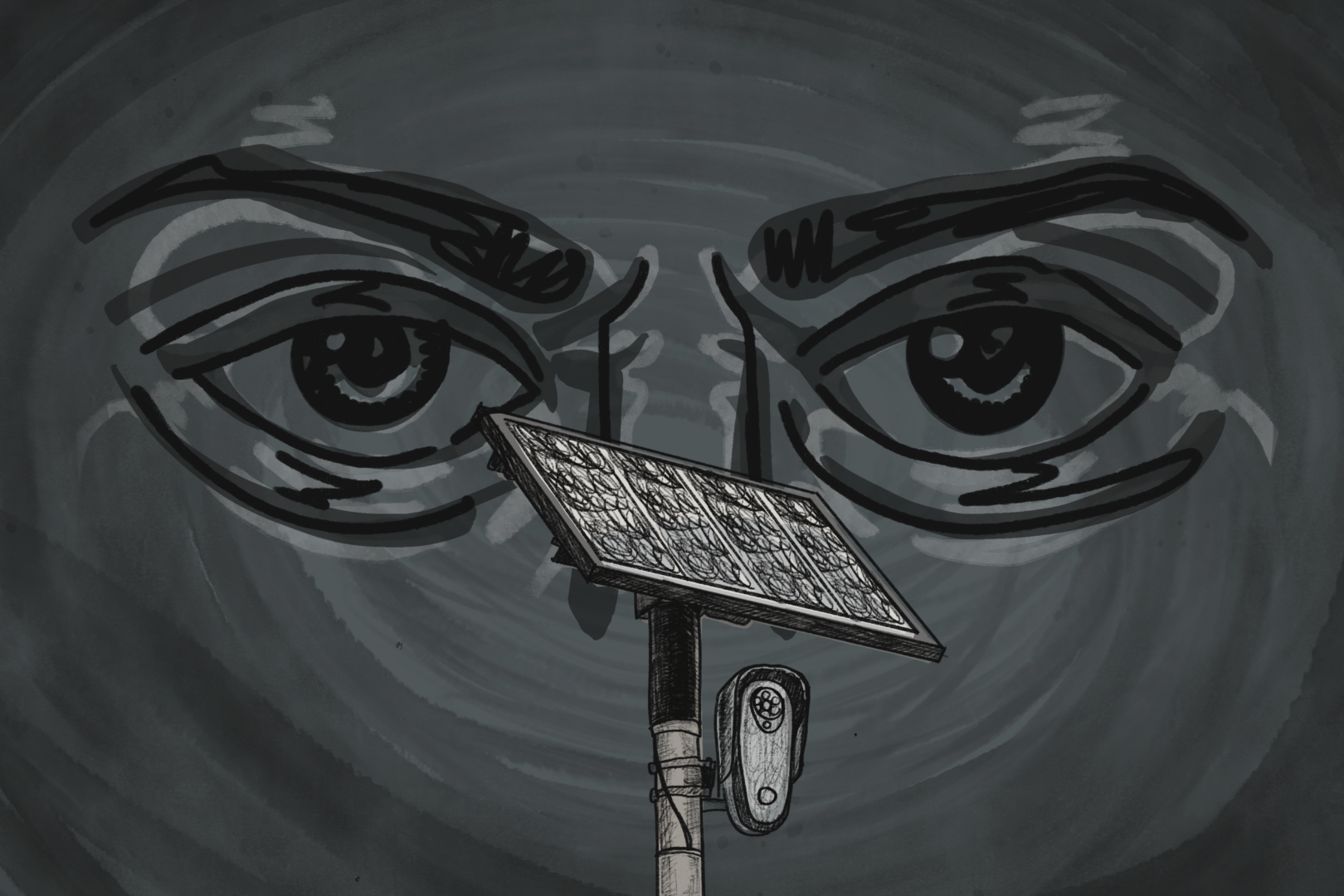
This latter option can be especially difficult to achieve today due to the overwhelming number of eyes in both the physical and digital world.
The use of “security cameras”
When it comes to the former, security cameras are omnipresent. However, these cameras are not usually connected to a wider network.
If they were, they would be much like the type of “security camera” found in Flock cameras located throughout the United States, including Houston.
They are purportedly automatic license plate readers, but the Harris County Sheriff’s Office also utilizes that functionality and a facial recognition technology called Clearview AI.
With these technologies located throughout the city, a person can potentially be tracked across miles and miles, creating a record of their movements that can be accessed by people with the right credentials.
In a world where the government grows ever more untrustworthy, this violation of privacy only creates further opportunities for personal information to be used against someone.
When posts become data
Indeed, the government already collects and disseminates information on social media wantonly.
The Brennan Center for Justice notes that there are limits on how the government may collect information from social media through the Privacy Act and individual social media platforms, though the former is very broad in its scope.
In addition, both of those types of limitations may be ignored by the government, especially in an age where law often seems more like a suggestion than anything else.
That information, when collected, is used by government agencies, including the FBI, DHS and the State Department. The Brennan Center for Justice reports that departments may share information collected on social media between them as they choose.
This grows more concerning considering the number of people who share their political thoughts on social media.
Though there is no reason to start self-censoring, there is reason to be concerned that, if the government were to shift further into authoritarianism, people could face consequences simply for expressing a different opinion.
Social media also does not necessarily mean a loss of anonymity for many who choose to go by an alias. They too could still be identified through various methods, including accidental recordings.
Privacy matters
For many, it can be hard to imagine why someone would willingly remain anonymous or go to great lengths to protect that anonymity.
Regardless of their reasons, those people exist and their wishes should be respected just as much as those who do not mind how their information is distributed.
Individually, this can be achieved by asking for permission before uploading content to social media or by warning others of Flock cameras in the area.
Moving up in scale, the world has a responsibility to regulate these violations of privacy and to actually enforce those regulations.
Privacy should not have to mean disappearing from the world. But as social media and cameras continue to make people easier to track, anonymity is becoming harder to protect and that should concern everyone.
opinion@thedailycougar.com