Safiyya Lambert/The Cougar
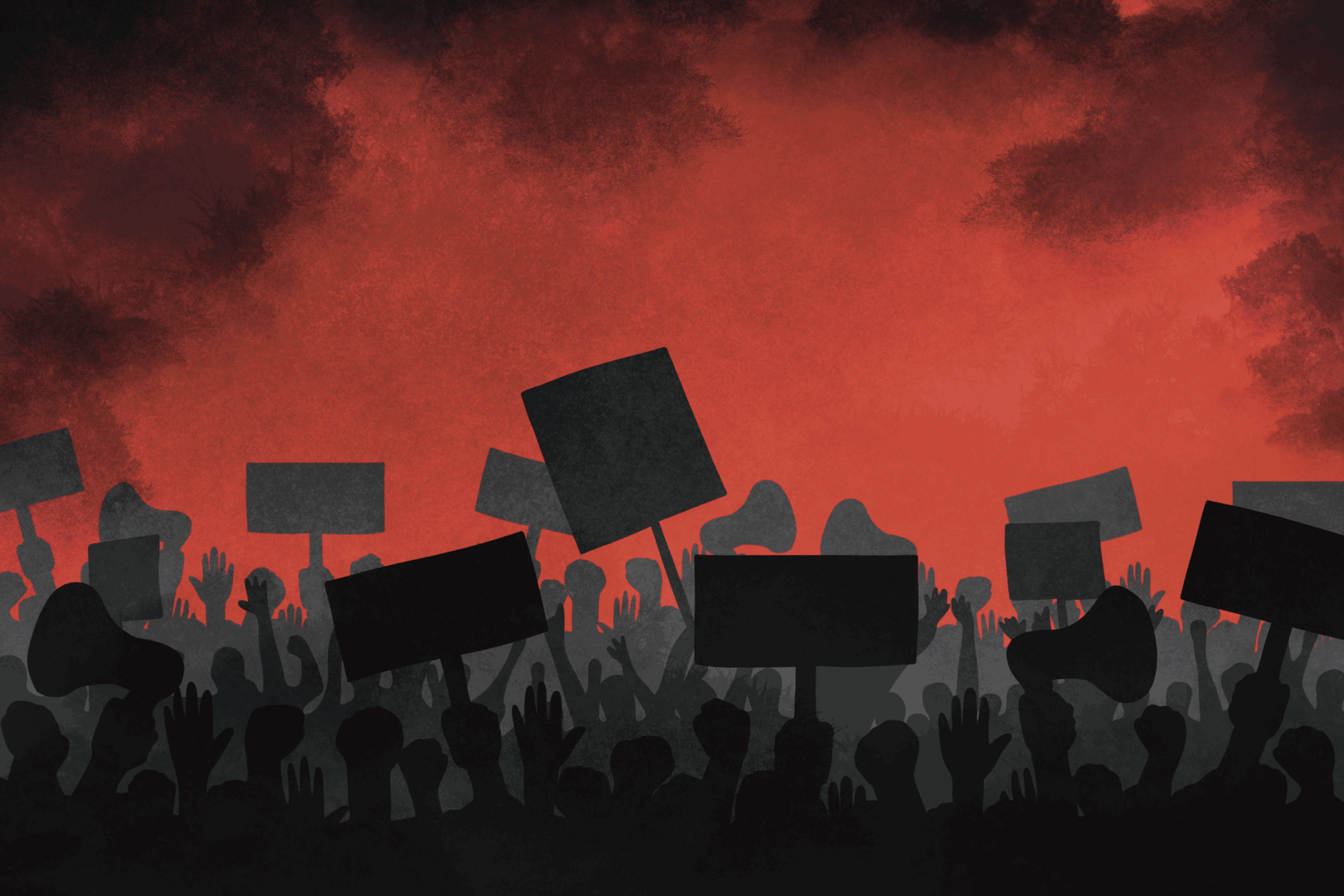
Campus today is quieter than it used to be. UH saw only half the number of student protests in the 2025-26 year compared to the year before, from 12 to six, according to an analysis by The Cougar. This marks the second consecutive year of decline from the 2023-24 academic year, which saw 15 protests.
Prominent student activists attribute the decline to changes in the national political environment, fears over deportation and a sense of frustration over the inefficacy of protests.
Recently, UH was also ranked 183 out of 261 schools in the 2027 College Free Speech Rankings with a score of 58 out of 100 and an overall grade of F in speech climate, published by The Foundation for Individual Rights and Expression.
But in Texas, recent legislative restrictions have also limited the scope and scale of student protests. Senate Bill 2972 went into effect Sept. 1, 2025, resulting in a host of new constraints.
Student protesters are now prohibited from using amplification devices, engaging in “expressive activities” during the last two weeks of a semester or between 10 p.m. and 8 a.m., making encampments and wearing facial coverings. Students must also present proof of identity upon request.
The bill has already been called unconstitutional and criticized for its vagueness and the potential for overregulation. But if its intended effect was to muffle student voices, it is perhaps succeeding.
“It is quite obvious that there is a lack of student protests and a lack of political outbursts compared to recent years,” said political science and philosophy senior Rafael Jimenez, who formerly served as the co-chair of the UH branch of the Young Democratic Socialists of America. “My first year here as a student, campus political culture was definitely much more intense. Then you compare that to events recently and it’s much more clear that student and faculty outrage isn’t as obvious as it was.”
A history of outrage
There certainly is no shortage of topics to be outraged about, according to student protestors. Jimenez points to safety for immigrant students and the rise of Flock cameras as two major areas of concern, in addition to what have become staples in the protesting sphere: Palestine, restrictions on DEI and specific to UH, safety on campus.
There are also other topics that have strayed to the edges of popular consciousness, but have historically been motivators for large-scale student protests: a new international war, major blows to environmental progress and large-scale funding cuts for U.S. health and humanitarian agencies.
In the 1960s and 70s, the Vietnam War provoked massive protests at college campuses across the nation; now, though the Iran war has received attention at UH, no such collective demonstrations have emerged.
Young people were at the forefront of climate protests in the 2010s, but college campuses have been largely silent about major rollbacks on climate policy. While the shutdown of USAID has triggered international humanitarian crises, no domestic movement has emerged.
“It’s a combination of complacency, student frustration and incredibly hostile state and federal policy that makes organizing on a campus like ours incredibly difficult,” Jimenez said. “I think we’re going to continue to see less political action as this policy becomes more and more aggressive.”
In the fall 2023 alone, students protested the closure of the LGBTQ Resource Center, held two protests for Palestine and two separate walkouts, one in support of Palestine and the other in protest of the closure of DEI offices.
Near the end of the semester, Students for Justice in Palestine also staged a sit-in on the steps of Student Center South aimed at raising awareness about ongoing boycotts of Starbucks and McDonalds due to their alleged funding of Israel.
The momentum persisted: in spring 2024, students protested everything from Senate Bill 17 to President Renu Khator’s rejection of Student Fee Advisory Committee recommendations and a new sculpture installation on campus.
Calls for divestment also escalated over the course of six separate student-led events: protests, an encampment, a week-long sit-in from 8 a.m. to midnight at the Student Center steps and a community prayer.
Even then, student protests weren’t always welcome: two students were arrested at the UH encampment. That same spring, students at the University of Texas at Austin set up a pro-Palestine encampment that was dismantled by law enforcement — who also arrested over 100 protestors.
Then, Donald Trump was elected as president. In addition to continued calls for divestment — which was the subject of four protests from fall 2024 to spring 2025 — students rallied against Trump himself and the effects of his policies on immigrant communities.
It was at this time that UH students also held what Deeds at UH President Mina Vuong remembers as an extraordinarily successful protest. The focus? Safety on campus after a series of high-profile crimes.
“It was something that I could noticeably see that a lot of students were involved in — not just students in organizing, but also just students who cared or were affected or passionate about student safety on campus,” Vuong said. “I felt very good about that protest.”
Both Vuong and Jimenez agree that protests dwindled in the 2025-26 academic year — but not immediately. Even after SB 2972 went into effect, there were four student protests in the fall, including a hunger strike for divestment.
In the spring, there were only two: a protest against the deadly crackdown on Iranian demonstrators and a call for divestment at a Board of Regents meeting.
Vuong doesn’t attribute the decline to state policy, though — she said she actually didn’t know that SB 2972 existed.
“I think a very, very big reason that I had no idea is that you don’t protest on these people’s terms,” Vuong said. “These are the oppressors and the very institutions that we are protesting against. It’s not very effective to protest on their terms. That would defeat the whole purpose of the protest.”
Yelling into a void
But students often don’t have a choice anymore. Without megaphones or speakers, students are having to simply cup their hands and shout their message, according to Jimenez.
They’re also scared about potentially being surveilled at protests or risking their visa status. Even those who aren’t concerned about their immigration status still have to contend with the threat of facing criminal prosecution.
“It hinders the ability to create a proper disruption,” Jimenez said. “If you’re unable to really do what a protest is supposed to do and be loud and somewhat disruptive, then what’s the point? You might as well just write a little notecard to President Renu Khator and pray that she reads it.”
It feels like yelling out into a void. Futile and potentially perilous, Jimenez said.
But that’s not to say student activists have been idle — protest is far from the only form of political expression available to the American people.
Politically active student organizations, from YDSA and SJP to the Progressive Student Union and Coogs RISE, were hosting regular meetings and film showings and training sessions even as protests declined in number.
“It’s this internal dissent that if these traditional types of protest aren’t working, what else can we do?” Jimenez said. “As long as UH and the state government try to continue limiting these protests, I think the conversation is always going to be: What else can we do in order to get our message across?”
It still isn’t certain what campus political life will look like this year. Jimenez, who will be a member-at-large of YDSA, plans to prioritize the comfort and safety of students.
“That’s one of the most heartbreaking things about being a student organizer: at the end of the day, we are still students, and we still have all our lives ahead of us,” Jimenez said. “Organizing is just an unfortunate thing that we have to do because we feel like something is so unjust that we have to do it.”
A note on the methodology: Protests are defined by the language used by the organizing groups. For instance, while healthcare advocacy efforts by graduate students in spring 2026 garnered widespread attention, Graduate Student Solidarity student organizers did not define their press conference as a protest.
Protests included in the analysis were led by or involving UH students, and took place either on-campus at UH or at the location of a UH Board of Regents meeting.
Further, ‘one’ protest is typically contained on one day and oriented on a single topic, but longer demonstrations that centered on a single theme were counted as just one protest. The hunger strike led by Students for Justice in Palestine lasted for weeks but is counted as one protest.
news@thedailycougar.com