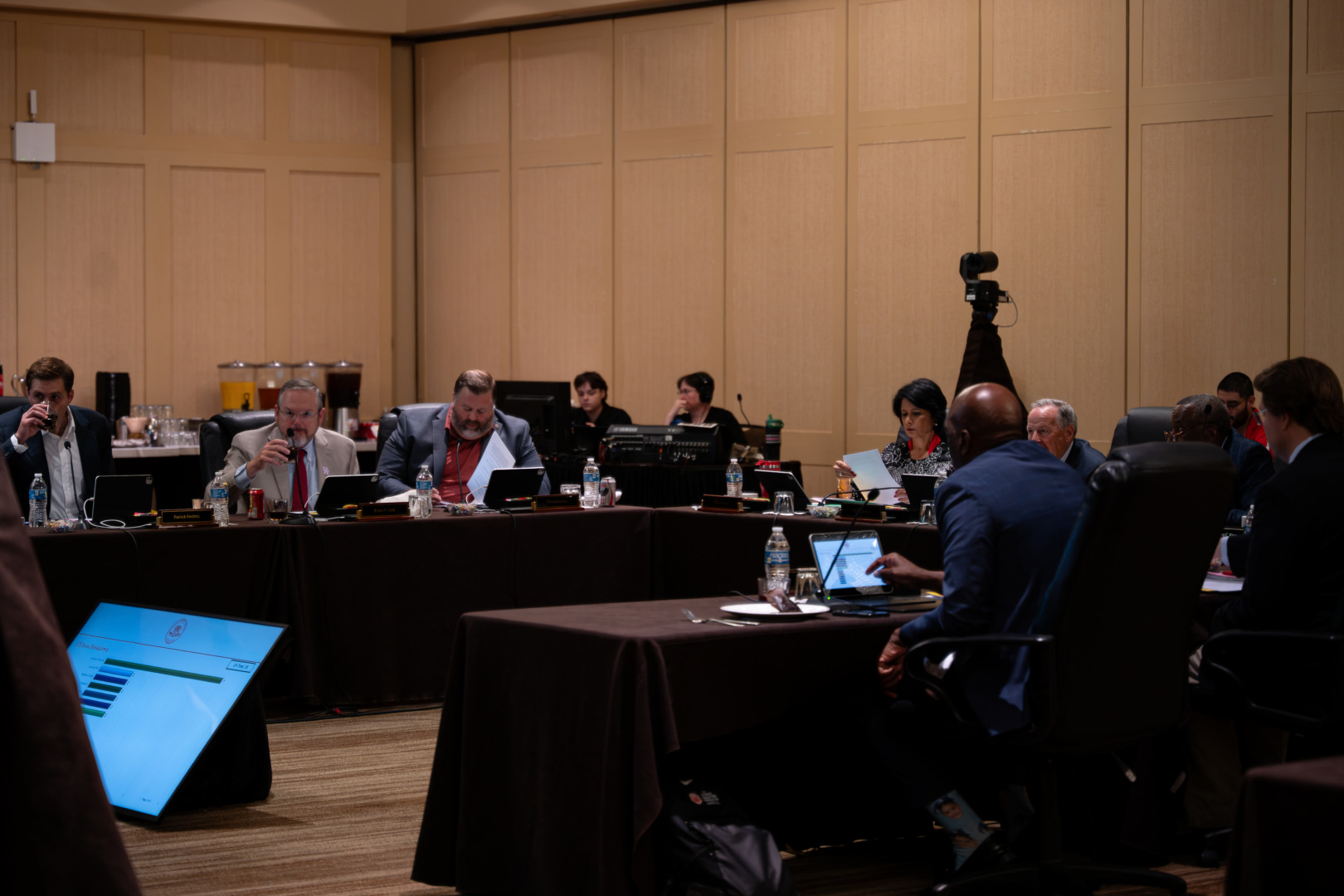
The Board of Regents gathered for the August meeting, on Thursday, August 20, 2026, in Houston, Texas. | Gillian Wisniewski/The Cougar
The UH System Board of Regents met on Aug. 20 at the Hilton Hotel for its first meeting of the 2026-27 year. During the meeting, the regents discussed and approved upcoming cuts to the curriculum, introduction of new programs and updates on the Centennial Project.
Approved cuts to the curriculum
The regents voted unanimously to approve the removal of 133 courses from the UH core curriculum. These cuts exceed the proposed 101 course cuts by 32.
The courses were cut due to the passage of Senate Bill 37, which required all university systems’ boards of regents to create committees to review their curricula every five years and reject any courses that they don’t see as impartial or suited for workforce demands.
After the review and subsequent comments from faculty, the core curriculum now has 147 core courses, said general counsel member Dona Cornell
The University created its own framework for evaluating each of its 280 core courses, which states that a core class must be foundational and fundamental, prepare students for civic and professional life, equip students for the workforce and ensure knowledge that warrants accreditation.
Cornell explained that if a core course fails to satisfy all four of the University’s criteria, it would no longer be a part of the core curriculum. However, the course would still be available for major or general elective requirements.
Students who spoke at the meeting argued that courses being cut will lead to them being dissolved in the future.
“Think about our George Washington, who fought for our nation, our MLK, who helped desegregate the system or our Rosa Parks, who chose not to stay silent,” said Vice President of SGA Ian Kariuki. “10 years from now, as a student, if I see a class that does not align with my major or minor, I will be less likely to take it, leading to classes being removed.”
Other students in the meeting claimed that the removal of certain core courses undermines the diversity and independence of the student body.
“The system is treating students like we are mindless drones; it is important to remember we are independent thinkers deserving of quality education and we deserve classes that represent the rich diversity of our campus, city, nation and world,” said anthropology and history senior Haylee Snyder. “According to section two, the board is responsible for protecting intellectual exploration and freedom; by cutting classes from the curriculum, how is the board fulfilling their obligations”
Professors who spoke at the meeting expressed their frustration, claiming that educators are being excluded from the decision-making process in favor of faculty and administrative leaders.
“Curriculum needs review, I certainly don’t deny that, but this is supposed to be a conversation among educators,” said director of classical studies Richard Armstrong. “It is ironic that after summer, when everyone is talking about Christopher Nolen’s “Odyssey,” we see that a course that deals with a hero like Odysseus is no longer foundational enough for the core curriculum.”
Frustration from professors came not only from an educational view but from the sight of government interference in education as well.
“This summer’s actions have proven me naive and now force me to recognize that our leadership bends to the whims of politics,” said English professor Maria Gonzalez
New programs
UH-Clear Lake will inaugurate a Bachelor of Applied Arts & Sciences in Geographic Information Science and Cartography beginning spring 2026.
The degree will offer an interdisciplinary hybrid program for students to analyze, manage and visualize spatial data using industry-standard GIS technologies, as stated by the board.
UH will induct a Ph.D. in engineering data science and AI in spring 2026. The board stated the program was designed after research scientists identified AI and data-related careers as high-demand and high-wage occupations.
Despite the new programs, two graduate certificates will be closed due to low demand and minimal student engagement: C.T Bauer College of Business business advisory and internal audit, as well as oil & gas accounting.
Centennial master plan
Alongside the Centennial Construction Project, the University is also planning to construct a new pavilion in the Centennial Plaza and a patio at Eric’s Restaurant to create more innovative social spaces.
All centennial projects are set to be completed by spring 2027.
Other construction initiatives include a new dining hall to replace Moody Dining Hall. Located in the heart of the Housing District, the hall will have three floors, eight food venues, a covered outdoor patio and seating for approximately 800 guests. The building is projected to be finished by Dec. 2027.
The University is planning to build an Innovation Hub, which houses the Dakri Center for Economic Inclusion and Aspire Institute. The hub is four floors and includes maker spaces, laboratories, and administrative offices and is planned for completion in Jan. 2028.
Scheduled for May 2028, the University is building a dedicated space for the Hobby School of Public Affairs to replace the previous John M O’Quinn Law Library.
news@thedailycougar.com